Ep60 Your Home Has a Story to Tell. Are You the Main Character?

DIY Home Décor: Does Your Home Tell Your Story? There’s not a single room in our house that hasn’t been affected by my furniture-flipping obsession. And I’m not just talking about furniture. I’ve often said that if it doesn’t move, it’s in danger of getting painted! But here’s something I’ve been thinking about lately. We furniture artists spend hours making things beautiful for other people’s homes. We learn to paint, stencil, create texture, combine colors, and turn outdated furniture into something special. But are we using those same skills to make our own homes a reflection of who we are? You know that old saying about the cobbler’s children having no shoes? I don’t want that to be us. Over the years, I’ve used my furniture-artistry skills all over our house. One of my favorite projects is an antique door I repurposed into entryway décor. I spray painted one side … Read more
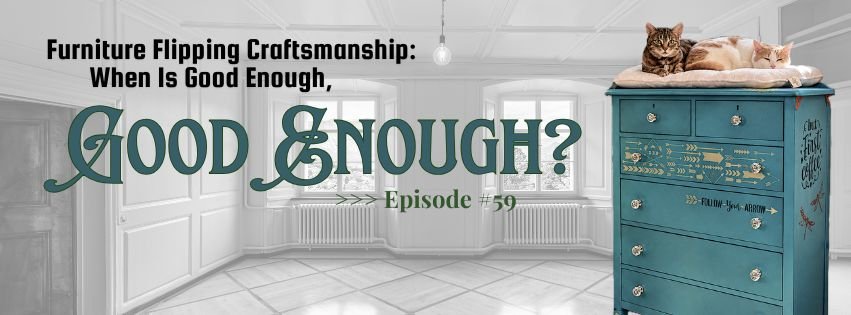

Ep59 Furniture Flipping Craftsmanship: When Is Good Enough, Good Enough?

Furniture Flipping Craftsmanship: When Is Good Enough, Good Enough? Do you really have to fix every dent, scratch, and imperfection before selling a piece of furniture? Well, yes. And no. Helpful, right?  One of the hardest things to learn as a beginning furniture flipper is the difference between a flaw that adds character and a problem that needs fixing. And believe me, there IS a difference. I have an antique dresser in our RV that I absolutely love. It has a history, and I don’t want to erase every little reminder of the years it spent in someone else’s home. I want that dresser to still whisper a little about the lives it lived before mine. I don’t want it screaming at me because I can’t get the drawer open. That’s the difference between preserving character and overlooking a problem.   Excellence Doesn’t Mean Perfection When you’re learning furniture refinishing, … Read more

Ep58 I Broke the “Rules” on My Antique Dresser — Specialty Paints for the Win

Stop Making Furniture Redesign Harder Than It Needs to Be Somewhere along the way, furniture artists can get the idea that the harder way must be the better way. I don’t buy that. I like fast and easy—as long as fast and easy doesn’t mean skipping necessary prep or sacrificing the quality of the finished piece. If a product can give me the result I want in less time, I’m perfectly happy to let it do its job. That’s exactly what happened with the antique dresser I redesigned for our RV. Instead of opening a can of traditional furniture paint and brushing or spraying on a conventional base coat, I reached for spray paint. Actually, I reached for three cans of spray paint. Then came stencil paint, several different metallic paints and a glossy topcoat. Did I break a few of the unofficial “rules” of furniture redesign? Probably. But knowing … Read more

EP57 Well, THAT Wasn’t on My List of Things to Do Today

Have you ever started the day with a perfectly reasonable to-do list, only to have something happen that threw the whole thing out the window? I recently needed to can some tomatoes before leaving on a trip. I had three jars ready, but I wanted a full canner, so I grabbed a giant can of what I thought were whole tomatoes from the pantry. It was tomato paste. I kicked myself for about thirty seconds, then figured I might as well make tomato sauce. Ten extra quarts and three canner loads later, I finally finished around midnight. So much for saving time. Furniture flipping can be a lot like that. You start with a picture in your head of what a piece will become. Then the paint doesn’t look right, a repair takes longer than expected, or you realize the design simply isn’t working. That’s what happened with a dresser … Read more

Ep56 Lime Paint — Tricky, Expensive & Absolutely Beautiful

Mineral Paint and Lime Paint: Two Names Worth a Closer Look This episode on the Flipping Furniture For Profit podcast is the second half of a two-episode look inside the paint can. In Episode 55, we talked about mineral paint—and why the word mineral doesn’t describe one universal formula. Here in Episode 56, we’re moving into lime paint: a beautiful specialty finish with plenty of movement, character, expense, and, yes, a learning curve. If you landed here from my Mineral Paint + Lime Paint poster or reel, you’re in the right place. You can explore lime paint below, then visit What Exactly Is Mineral Paint? — Episode 55 to hear the other half of the conversation.   Lime Paint: When Beautiful Wins Not every paint that creates a beautiful finish makes good business sense. I learned that while using Pure & Original Fresco lime paint on an inexpensive serving cart I’d … Read more

Ep55 What Exactly Is Mineral Paint?

Does the Paint Jar Label Tell You Exactly What’s Inside? When you’re new to furniture flipping, it’s easy to assume the name on a paint jar tells you exactly what’s inside. Mineral paint sounds pretty straightforward. It’s mineral paint, right? Well…not necessarily. One of the biggest lessons I’ve learned after years of painting furniture is that product names and marketing terms don’t always tell us everything we need to know. Two paints associated with the word mineral can have very different formulations and behave very differently on furniture. That doesn’t mean there’s anything wrong with either product. It means we need to learn to look beyond the label. A good example is Fusion Mineral Paint. Fusion explains that its binder is 100% acrylic resin while its pigments are derived from minerals. If you only saw Mineral Paint on the front of the jar, you might have assumed something different. And … Read more

Ep54 A Furniture Flipper’s Guide to Antiques: Why Is That Doll Looking at Me?

Just Because It’s Old Doesn’t Mean It’s Valuable One of the easiest assumptions to make when you’re new to furniture flipping is that old furniture must be valuable. It’s old. It’s solid. It has dovetails. Grandma had one. Surely somebody is going to pay a fortune for it. Not necessarily. One of the biggest lessons I’ve learned from buying and selling furniture is that age alone doesn’t create value. A piece may be beautifully made and more than a hundred years old and still be difficult to sell. Another piece from a much later period may have buyers fighting over it. Why? Because value needs a beholder. A buyer may care about the maker, rarity, construction, original finish or history. But ultimately, somebody has to actually want that piece enough to pay for it. That matters to furniture flippers because we have another decision to make: What should we do … Read more

Ep53 Alkyd & Urethane Paint — Pretty Is Nice, but Will It Last?

Alkyd & Urethane Paint — Pretty Is Nice, But Will It Last? Pretty furniture is easy to photograph, but the real test is what happens after it leaves your workshop. One of the most important things I’ve learned through years of painting furniture is that there isn’t one “best” paint. There’s only the paint that’s best suited to what you’re trying to accomplish. That’s why I keep coming back to this advice: Learn your products and choose according to your need at the time. Alkyd and urethane paints are a good example. Products such as Sherwin-Williams Emerald Urethane are designed to create a hard, durable finish that can stand up to frequently used and cleaned surfaces. That matters when you’re selling furniture, because your responsibility doesn’t end when you take the pretty Marketplace pictures. Your work goes home with somebody. I’ve used different paints for different projects over the years, … Read more

Ep52 Acrylic Paint — What Works, What Changes & What Lasts

Acrylic Paint: Why Knowing Your Product Matters Acrylic paint sounds simple enough, right? You see acrylic on the label and assume you know what you’re getting. Not necessarily. One of the most important things I want you to learn as a furniture artist is this: the paint family tells you where to start, but it doesn’t tell you everything you need to know about the product. Think about those little bottles of acrylic craft paint you’ve probably seen at the store. I’ve used them for stenciling and decorative details for years. They’re acrylic. But so are some coatings specifically formulated to stand up to the everyday wear and tear we expect from furniture. In fact, professional wood coatings can use acrylics, polyurethane dispersions and blends of resin technologies to achieve different performance characteristics. Those products aren’t interchangeable just because they share the word acrylic. That’s why I’m always telling you … Read more

Ep51 Chalk-Type Paint — Loved by Some, Hated by Others, but Still On My Shelf

There was a time when chalk-type paint seemed to be everywhere. If you painted furniture, chances are you had a can or two sitting on your shelf. Today? Well…people have opinions. Some furniture painters still love it. Others wouldn’t touch it. Me? I still have it on my shelf, and there’s a pretty simple reason why. I know what it’s going to do. After you’ve painted enough furniture, you begin to get acquainted with your products. You learn which paints level beautifully, which ones need a little extra help, which ones work well for certain projects, and which ones you’d just as soon leave sitting on the shelf. I call that getting to “no-brainer land.” It doesn’t mean you’ve found the perfect paint. I don’t think there is one. It means you’ve gained enough experience that you don’t have to hold a committee meeting with yourself every time you open … Read more